
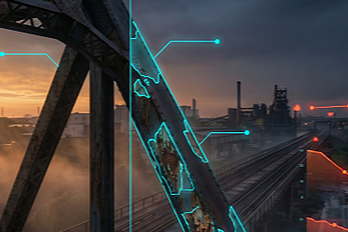
Convert reactive maintenance to predictive with scheduled, automated condition trending across your entire portfolio. Reduce maintenance costs by up to 40% & extend the life of your assets.
Asset Condition Monitoring & Predictive Maintenance Programs
For organisations that need consistent, repeatable condition data for more informed decisions.
ISO 9001
|
ISO 14001
|
ISO 45001
|
CASA ReOC
|
$20m Insurance
|
Bridge Lvl 1
|
ISO 9001 | ISO 14001 | ISO 45001 | CASA ReOC | $20m Insurance | Bridge Lvl 1 |
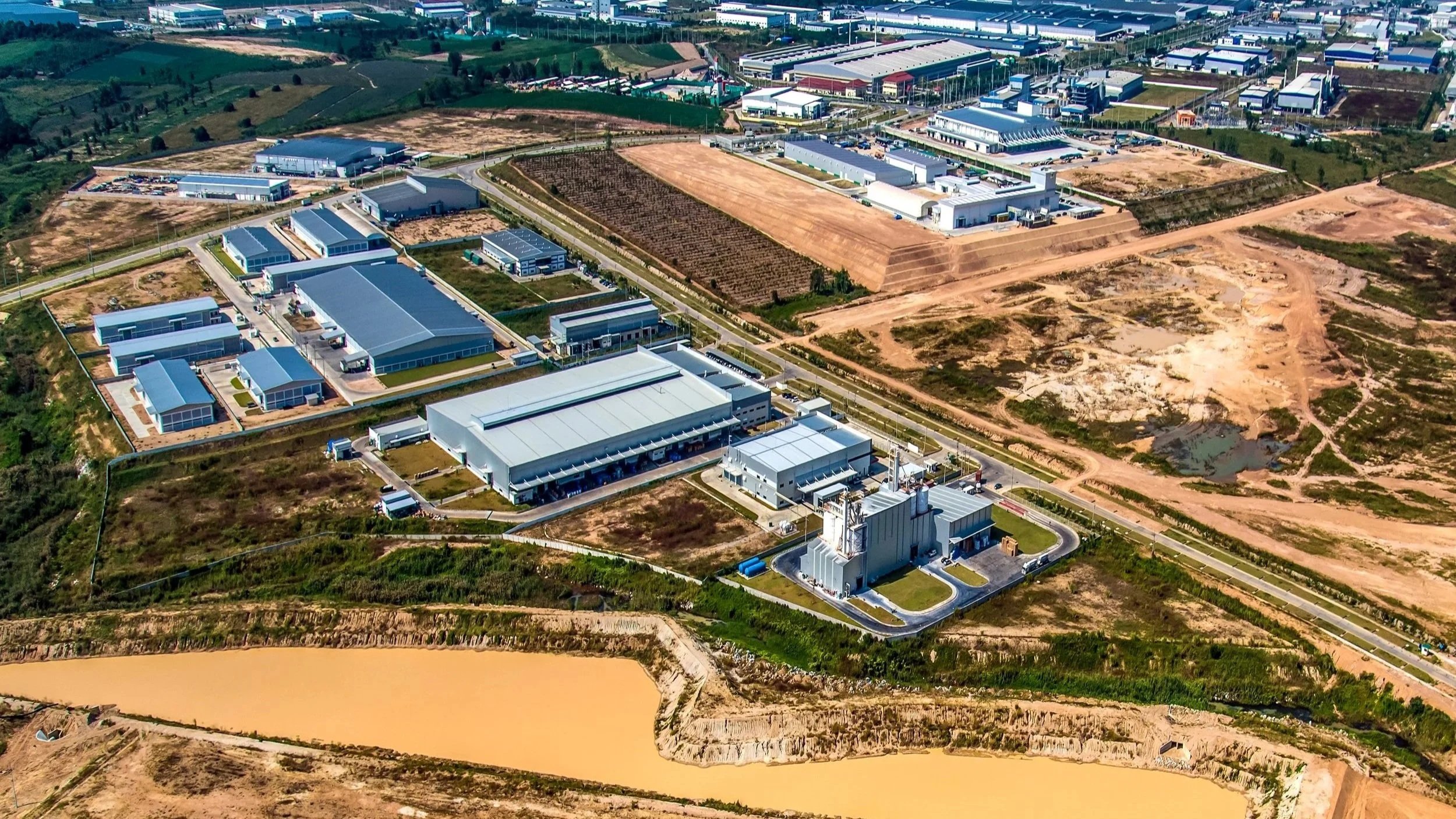
The Cost of Reactive Maintenance
Track multiple asset conditions and priorities over time with tracked, categorised, scheduled, and repeatable data, providing a defensible baseline for every inspection cycle and every expense.
Point-in-Time Blindness
One-off inspections create isolated snapshots. They lack the historical context needed to track degradation rates, hindering the effective forecasting of maintenance schedules with any degree of accuracy.Reactive Cost Multipliers
Fixing assets after they fail costs 3-5x more than planned interventions. You are forced into emergency repairs, unplanned downtime, and premium contractor rates.Compliance Gaps
Regulatory bodies demand documented monitoring and maintenance histories. Without a structured and, where possible, automated transparent governance framework, you risk compliance failures and increased liability exposure.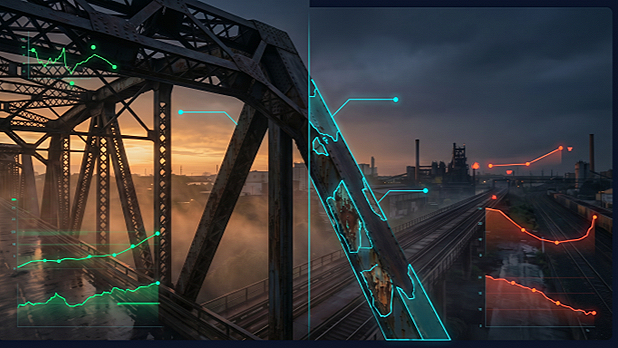
Predictive Maintenance & Condition Trends
We replace ad-hoc inspections with structured, scheduled monitoring cycles (monthly, quarterly, or annual). Our enterprise-grade governance framework ensures consistent data capture, trend analysis, QA protocols, and strict metadata control across your portfolio.Each survey compounds the intelligence of the last. Automated change detection identifies new defects, tracks the progression of existing ones, and calculates degradation rates across your entire portfolio. Your engineering team accesses a browser-based dashboard that shows portfolio-level condition status, individual asset drill-downs, and automated alerts when condition thresholds are breached. No software installation. No return site visits for data review. Integration with your existing asset management system enables automated work order generation when intervention thresholds are triggered.Automated Change Detection:
We utilise various software to automatically identify and highlight structural changes, corrosion progression, or thermal anomalies between inspection cycles.Portfolio-Level Dashboards:
Access a centralised, secure portal providing complete visibility over asset health across multiple sites, aligned to your internal categorisation process and integrated into your software stack, enabling data-driven capital allocation. Standardised Data Capture:
Our advanced drones with RTK positioning (+/-2cm accuracy) to ensure perfect and repeatable data alignment over time.-
"20-35% reduction in inspection costs vs manual methods."
(Struction Solutions, 2025)
-
“20-30% improvement in public sector capital and operational efficiency from digital twins”
(McKinsey, 2025)
-
“92% of companies tracking digital twin ROI see returns above 10%.”
(Visual Capitalist, 2025)
Why Engage DeepSky IQ Instead of building an In-House Program?
Significant Safety Improvements:
Outsourcing quickly removes the need for personnel to work at dangerous heights, in confined spaces, or in hazardous environments, reducing the risk of workplace injuries and fatalities.Scalability Without Standing Costs:
We can deploy our capabilities on demand for your scheduled monitoring cycles. You pay for capability & technology when needed, not year-round, avoiding the capital expenditure, idle assets and the compliance and training costs of an in-house team.Reduced regulatory, compliance, costs and knowledge burden.
Outsourcing allows companies to leverage specialised expertise, advanced technology, specialised certification, licensed staff, and ensure regulatory compliance, without the high overhead costs and those of building and training an in-house team and maintaining and replacing hardware. DeepSky IQ designs and executes repeatable monitoring frameworks tailored to your portfolios, infrastructure corridors and operational assets. Hiring our specialised teams eliminates the ongoing expenses of purchasing expensive equipment, software, and training. It also avoids the need for costly scaffolding or specialised access equipment.Multi-Environment, Single Provider:
We operate aerial drones, confined space drones, underwater ROVs, and ground-based 360 platforms. We create one unified digital twin from all environments on one coordinate system, giving you a complete view of your assets.Engineering-Grade Outputs:
We deliver RTK positioning with +/-2cm accuracy, with sub-centimetre levels of detail, calibrated IR radiometric thermal data, georeferenced orthomosaic, 3D point clouds, and digital twins. This ensures perfect data alignment over time for accurate condition trending.Independence and Auditability:
As an ISO 9001, 14001, and 45001 certified provider with $20M public liability, our independent third-party data is more defensible for compliance, insurance, and legal purposes than self-collected data.
Impact Across the Asset Lifecycle
From capture to prediction. Each monitoring cycle compounds the intelligence of the last.
Multi-Environment Capture
Aerial, confined space, interior, exterior, 360 ground-level, and underwater capture unified into a single coordinate system. One provider replaces multiple contractors with different standards and incompatible data formats.
Enterprise-grade sensors capture visual, thermal, LiDAR, multispectral, and ultrasonic data simultaneously. RTK positioning (+/-2cm) ensures perfect spatial alignment between inspection cycles for automated change detection.
Capability: All environments, one unified model
AI-Powered Processing & Defect Detection
Raw data is processed through our enterprise reality modelling platform. AI algorithms automatically classify defects by type (cracks, corrosion, spalling, coating degradation, deformation) and severity (minor, serious, critical) without manual review.
Automated change detection compares each survey against previous cycles, highlighting exactly what moved, grew, or degraded. Design-alignment analysis overlays as-built reality against original design models to identify deviations. Volumetric calculations quantify erosion, settlement, and material loss to engineering accuracy.
Capability: Automated classification, change detection, volumetrics
Browser-Based Digital Twin Delivery
Your monitoring data is streamed to any web browser via OGC 3D Tiles. No software installation. No specialist hardware. Your engineers measure directly in the model. Your executives view narrated 3D flythroughs. Your contractors access view-only links scoped to their work area.
Role-based permissions control access. Datasets of any size stream instantly through optimised 3D tiling technology. Share a single link with unlimited stakeholders across your organisation, supply chain, and regulatory bodies.
Capability: No software, unlimited access, role-based sharing
Predictive Lifecycle Intelligence
Time-series data across multiple inspection cycles reveals degradation rates and remaining useful life for every monitored asset. AI trend analysis identifies accelerating deterioration before it reaches failure thresholds, enabling planned intervention at optimal cost.
5D cost modelling links condition data to remediation budgets. 6D lifecycle analysis forecasts when assets will require replacement. 7D compliance mapping automates regulatory reporting against your obligation register. Each cycle makes predictions more accurate.
Capability: 4D-7D intelligence, predictive maintenance
Governance & Compliance Automation
Structured photogrammetry, LiDAR, and point cloud workflows with enterprise metadata standards produce audit-ready documentation every cycle. RTK validation, ground control QA, and accuracy verification ensure data is legally defensible.
Deliverables support contract administration, regulatory reporting, commissioning sign-off, dispute resolution, and portfolio governance. Independent third-party data (ISO 9001/14001/45001 certified) is more defensible for compliance, insurance, and legal purposes than self-collected data.
Capability: Audit-ready, legally defensible, automated reporting
Enterprise System Integration
All outputs export directly to your existing asset management platforms (SAP, Maximo, ArcGIS, and others) via open APIs and standard formats (LAS, GeoTIFF, CSV, GeoJSON, IFC). No manual data entry. No format conversion. No middleware required.
Portfolio-level dashboards provide cross-site benchmarking, capital planning visibility, renewal forecasting, and stakeholder reporting. Real-time IoT sensor feeds (8D) integrate directly into the digital twin for continuous remote monitoring between inspection cycles.
Capability: Direct integration, open formats, live monitoring
Calculate Your Saving
Every asset in your portfolio is degrading right now.

The question is not whether any defects exist. It is whether you detect them early at $5,000 or discover them at $500,000+.

Structured asset monitoring & management programs identify 60-70% of failures before they occur. Without one, you are paying the reactive premium on every unplanned event: emergency contractor rates, unbudgeted capital, insurance excess, downtime penalties, and regulatory scrutiny.

The cost of a monitoring program is a fraction of a single avoided failure.
What Is Reactive Maintenance Costing You?
Calculate the hidden cost of not having a structured monitoring program.
Your Annual Exposure
Every Month Without a Monitoring Program:
Your portfolio is accumulating $0 in undetected degradation risk per month. Defects that cost $2,000-$5,000 to remediate when detected early become $50,000-$500,000 emergency failures when missed. Industry data shows reactive maintenance costs 3-5x more than planned interventions. Each inspection cycle you delay means defects progress past the point of economical repair.
Let’s Work Together and Help Reduce Your costs
Frequently Asked Questions
What does a typical monitoring program look like?
A typical program begins with a baseline capture to establish current condition across your asset portfolio. We then define a scheduled inspection cycle (monthly, quarterly, biannual, or annual) based on asset criticality, degradation profile, and regulatory requirements. Each cycle uses automated flight paths to capture identical data from identical positions, ensuring perfect alignment for change detection. Data is processed with AI-powered defect detection and automated change highlighting. You receive a structured condition report, updated digital twin, trend analysis, and prioritised intervention recommendations.
How often should assets be inspected?
Inspection frequency depends on asset type, environmental exposure, degradation rate, and regulatory requirements. High-risk or rapidly degrading assets (coastal structures, chemical processing) may require monthly monitoring. Standard infrastructure (bridges, buildings, towers) typically operates on quarterly or biannual cycles. Stable assets in benign environments may only need annual baseline updates. The program adapts over time as condition data reveals actual degradation rates, allowing you to optimise spend against risk.
Can you monitor multiple sites across a portfolio?
Yes. Our programs are designed for portfolio-wide deployment across multiple sites, regions, and asset types. We standardise data capture and reporting across all your locations, providing a unified dashboard for comparative analysis and centralised asset management. This enables cross-site benchmarking, consistent condition scoring, and portfolio-level capital planning visibility. A single provider across all environments eliminates the coordination overhead of managing multiple contractors with different standards and data systems.
How much does a recurring monitoring program cost compared to ad hoc inspections?
Structured monitoring programs deliver 20-40% cost savings per inspection cycle compared to ad hoc engagements through standardised flight paths, automated processing pipelines, and volume-based pricing. The investment is further offset by early defect detection, which prevents failures that would otherwise cost 5-20x more in emergency repairs, unplanned downtime, and insurance excess payments. Longer-term agreements (2-3 years) provide better per-cycle pricing and allow meaningful trend baselines to develop.
What types of assets can be included in a monitoring program?
Our programs cover assets across all environments: aerial (roofs, facades, towers, solar arrays, powerlines), ground-level (roads, pavements, retaining walls, car parks), confined spaces (tanks, culverts, tunnels, ducts), and underwater (wharf piles, pipelines, dam walls, seawalls). We operate as a single provider across all environments, eliminating the need to coordinate multiple contractors. Programs can include any combination of asset types within a single contract.
How does a monitoring program differ from a one-off inspection?
A one-off inspection provides a single point-in-time snapshot. A monitoring program delivers trending data that tracks degradation rates, validates repair effectiveness, and enables predictive maintenance scheduling. With repeated captures using identical flight paths and sensor settings, our AI algorithms detect changes as small as 2mm between inspection cycles. This transforms your maintenance strategy from reactive to predictive, reducing total lifecycle costs by 30-50% and extending asset service life by 15-25%.
What data and reports do we receive from each monitoring cycle?
Each cycle delivers a structured condition report with defect identification, severity ratings, and recommended actions. Standard deliverables include high-resolution imagery, 3D point clouds, thermal overlays, AI-generated defect classification, and engineering measurement data. You also receive automated trend analysis comparing current condition against previous cycles. Reports are delivered in open formats compatible with SAP, Maximo, ArcGIS, and accessible via a browser-based 3D platform with no software installation required.
What is the minimum contract term for a monitoring program?
We offer flexible program structures starting from 12-month agreements with monthly, quarterly, or biannual inspection cycles. Longer-term agreements (2-3 years) provide better per-cycle pricing and allow us to establish meaningful trend baselines. There is no lock-in beyond the agreed term. For clients wanting to trial the approach, we offer a pilot program covering a representative subset of assets over 2-3 cycles before committing to a full portfolio program.